

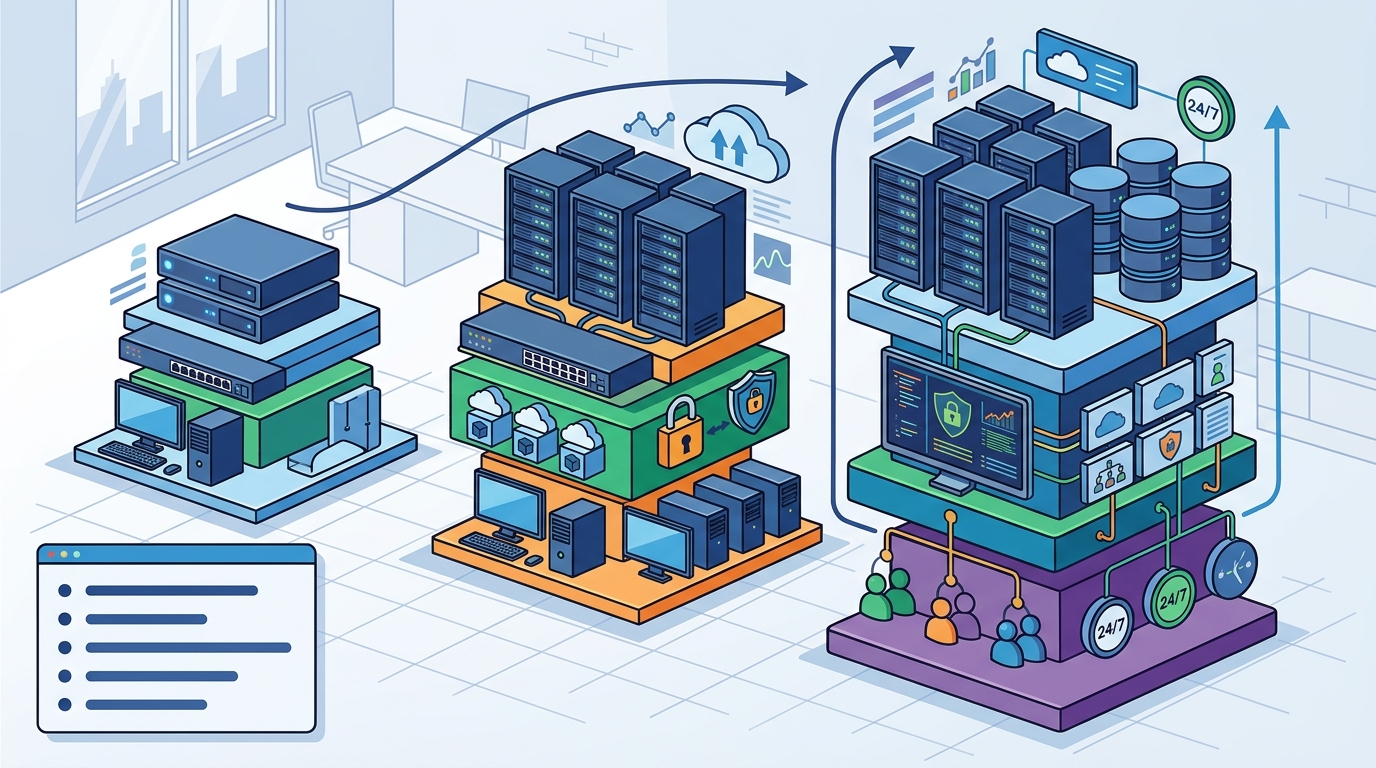
Managed IT service pricing tiers differ by company size and needs because costs scale with user count, infrastructure complexity, and compliance requirements. Small businesses typically pay per-user fees for basic support, while mid-sized firms require tiered packages covering cybersecurity, cloud management, and 24/7 monitoring. Rivell structures its New Jersey managed IT services to align these tiers with specific operational risks and growth stages.
Small Business Pricing: Per-User Simplicity
For organizations with fewer than 25 employees, pricing is almost exclusively per-user. This model covers endpoint management, help desk support, and basic security monitoring. The primary driver is the number of active devices and users requiring access to business applications. According to industry data, 46% of organizations report cutting IT costs by 25% or more after adopting managed services, a benefit most visible at this scale. Rivell’s managed IT services for small businesses focus on predictable monthly fees that eliminate the need for full-time in-house IT staff.
Mid-Sized Firms: Complexity and Compliance
As companies grow between 25 and 100 employees, pricing shifts from simple per-user rates to tiered packages based on infrastructure complexity. These tiers often include advanced cybersecurity, disaster recovery, and cloud migration support. The cost increase reflects the need for specialized skills, such as a Virtual CISO, to manage regulatory compliance and threat detection. Rivell offers Virtual CISO services to provide executive-level security oversight without the overhead of a full-time hire. This tier is critical for firms handling sensitive data or operating in regulated industries.
Enterprise and Multi-Site: Customized SLAs
For larger organizations or those with multiple physical locations, pricing is customized based on Service Level Agreements (SLAs) and uptime guarantees. These contracts often include dedicated account managers, 24/7/365 monitoring, and guaranteed response times. The focus shifts from basic support to business continuity and strategic technology planning. Rivell’s managed IT services in New Jersey accommodate multi-site environments by integrating network design, cloud hosting, and physical security systems. This approach ensures that as a business expands, its IT infrastructure scales without introducing new vulnerabilities.
Impact of Industry-Specific Needs
Industry requirements significantly influence pricing tiers. A healthcare practice, for example, requires HIPAA-compliant data handling and secure communications, which adds to the base cost. Similarly, a manufacturing firm may need integration with industrial IoT devices and robust network security. Rivell serves diverse sectors, including managed IT services for manufacturing and healthcare, tailoring packages to meet specific regulatory and operational demands. These specialized needs often justify higher pricing tiers due to the specialized expertise required.
Co-Managed vs. Fully Outsourced Models
The choice between co-managed and fully outsourced models also affects pricing. Co-managed IT services allow internal teams to retain ownership while a provider fills capability gaps, often resulting in a hybrid cost structure. Fully outsourced models transfer all responsibilities to the provider, typically at a higher per-user rate but with greater predictability. Rivell’s comparison of co-managed and managed IT services helps businesses determine which model best fits their current staffing and budget. This decision directly impacts the final pricing tier and the scope of services included.
Key Takeaways
- Small businesses typically use per-user pricing for basic support and security.
- Mid-sized firms pay for tiered packages that include advanced cybersecurity and compliance.
- Enterprise pricing is customized based on SLAs, uptime guarantees, and multi-site complexity.
- Industry-specific regulations, such as HIPAA, can significantly increase pricing tiers.
- Co-managed models offer a hybrid cost structure for firms with existing IT staff.
- Rivell aligns pricing with specific operational risks and growth stages in New Jersey.
Frequently Asked Questions
What is the main factor that determines managed IT pricing?
The primary factor is the number of users and devices, combined with the complexity of the infrastructure and the level of security required.
How does company size affect the pricing model?
Smaller companies usually pay per user, while larger companies pay for customized packages based on infrastructure complexity and service level agreements.
Do regulated industries pay more for managed IT services?
Yes, industries with strict compliance requirements, such as healthcare or finance, often pay more due to the need for specialized security and audit capabilities.
What is a Virtual CISO and how does it affect pricing?
A Virtual CISO is an external security expert who provides strategic oversight. Adding this service increases the pricing tier but reduces the need for a full-time executive hire.
Can I switch from co-managed to fully outsourced services?
Yes, businesses can transition between models as they grow. Rivell helps evaluate the right model based on current staffing and future growth plans.
Where can I find more information about Rivell's services?
You can explore Rivell's comprehensive offerings on their managed IT services and cybersecurity homepage.