

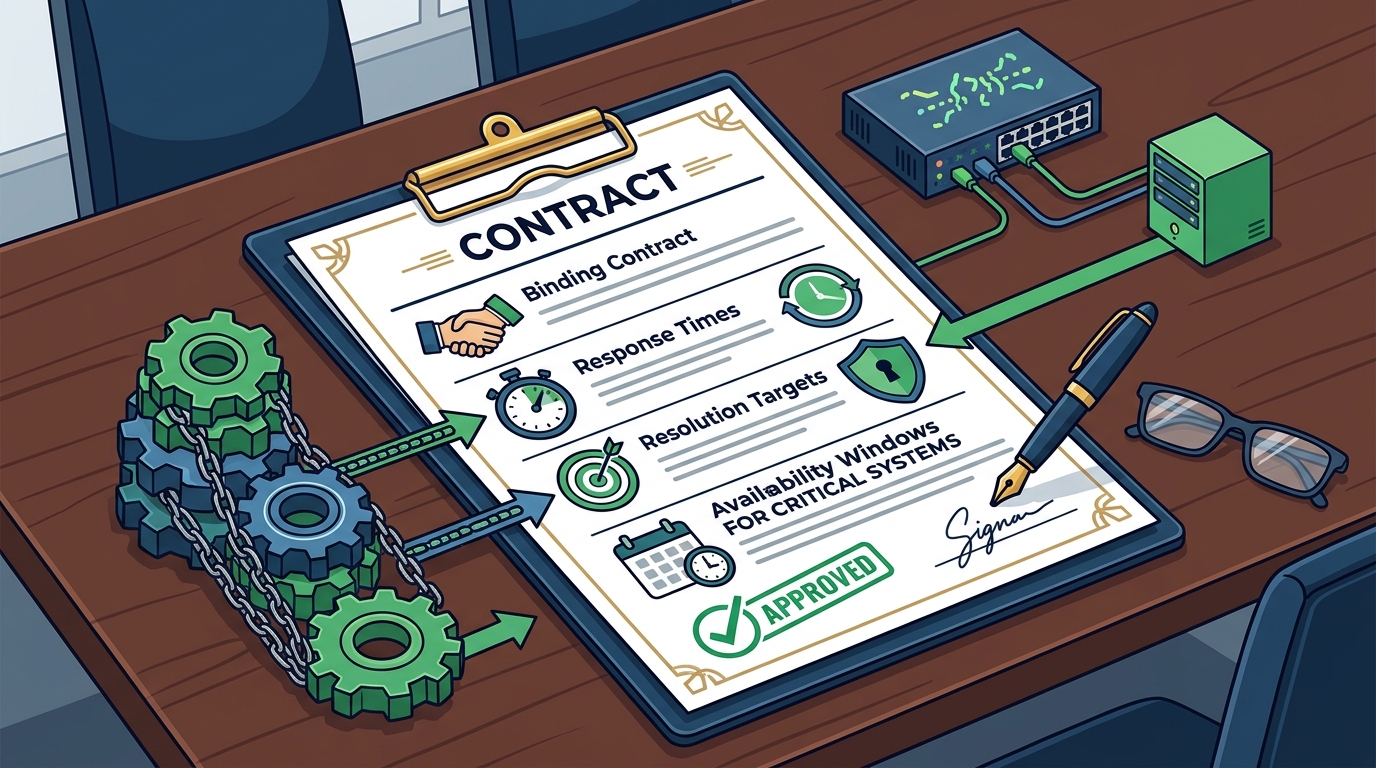
A service level agreement (SLA) is a binding contract that defines measurable performance commitments between a business and its IT support provider. It should guarantee specific response times, resolution targets, and availability windows for critical systems. Without these clear definitions, a business cannot hold a provider accountable for downtime or security failures. Rivell emphasizes that an SLA must align with actual business operations, not just generic IT metrics.
Defining Response and Resolution Times
Establishing System Availability and Uptime
System availability is the percentage of time that critical IT infrastructure remains operational and accessible to users. Businesses often assume that 99.9% uptime is the industry standard, but this figure allows for approximately 8.7 hours of downtime per year. For operations that run 24/7, this may be unacceptable. The SLA should define how uptime is measured, including whether maintenance windows count against the total. It should also specify the consequences of missing these targets, such as service credits or penalties. By clearly defining availability, a business can ensure that its provider is contractually obligated to maintain the stability required for daily operations.
Specifying Security and Compliance Obligations
Cybersecurity is no longer an optional add-on; it is a core component of IT support. The SLA should explicitly state the provider's responsibilities for threat monitoring, patch management, and incident response. For instance, it should define how quickly critical security patches are applied to endpoints and servers. It should also outline the provider's role in incident response, including communication protocols and escalation paths. In regulated industries, the agreement must address compliance requirements, ensuring that the provider's practices align with standards like HIPAA or SOC 2. This section of the SLA protects the business from liability in the event of a data breach.
Clarifying Support Coverage and Escalation Paths
Support coverage defines when and how users can access technical assistance. The SLA should specify the hours of operation for the help desk, including whether support is available 24/7 or only during business hours. It should also define the escalation path for unresolved issues, detailing which team or individual takes ownership when a problem exceeds a certain threshold. For example, a Tier 1 issue that remains unresolved after four hours should automatically escalate to a Tier 2 engineer. This structured approach prevents issues from falling through the cracks and ensures that complex problems receive the appropriate level of expertise. Clear escalation paths reduce frustration and improve overall user satisfaction.
Aligning SLA Metrics with Business Goals
Ultimately, an SLA is only as valuable as its alignment with business objectives. The metrics chosen should reflect what matters most to the organization, whether that is minimizing downtime, ensuring data security, or maintaining user productivity. A generic SLA may look impressive on paper but fail to address the specific risks and priorities of the business. By customizing the agreement to include relevant key performance indicators, a business can ensure that its IT provider is focused on the outcomes that drive success. This alignment transforms the SLA from a legal document into a strategic tool for operational excellence.
Key Takeaways
- Response time and resolution time are distinct metrics that must both be defined in the SLA.
- Uptime guarantees should specify how maintenance windows are handled and what penalties apply for missed targets.
- Security obligations, including patching and incident response, must be explicitly stated in the agreement.
- Escalation paths should clearly define when and how issues move to higher-level support teams.
- SLA metrics should be customized to reflect the specific operational goals and risks of the business.
- Service credits or penalties provide financial accountability for providers who fail to meet agreed-upon standards.
Frequently Asked Questions
What is the difference between response time and resolution time?
Response time is the duration until a technician acknowledges a support ticket, while resolution time is the duration until the issue is fully fixed. Both metrics are essential for holding a provider accountable.
How much downtime does 99.9% uptime allow?
99.9% uptime allows for approximately 8.7 hours of downtime per year. Businesses should evaluate whether this level of downtime is acceptable for their operations.
Should security responsibilities be included in the SLA?
Yes, security responsibilities such as patch management and incident response should be explicitly defined in the SLA to ensure clear accountability.
What happens if a provider misses an SLA target?
The consequences depend on the contract terms, which may include service credits, penalties, or other remedies. These should be clearly defined in the agreement.
How often should an SLA be reviewed?
An SLA should be reviewed annually or whenever significant changes occur in the business's IT environment or operational requirements.
Conclusion
A well-crafted service level agreement is a critical tool for ensuring reliable IT support and protecting business operations. By defining clear metrics for response, resolution, availability, and security, a business can hold its provider accountable and align IT services with strategic goals. Rivell works with New Jersey businesses to develop SLAs that reflect their specific operational needs and risk profiles. To discuss how a customized SLA can support your organization, .